Interview with LianHe ZaoBao
By: Yukna on ( Updated: )
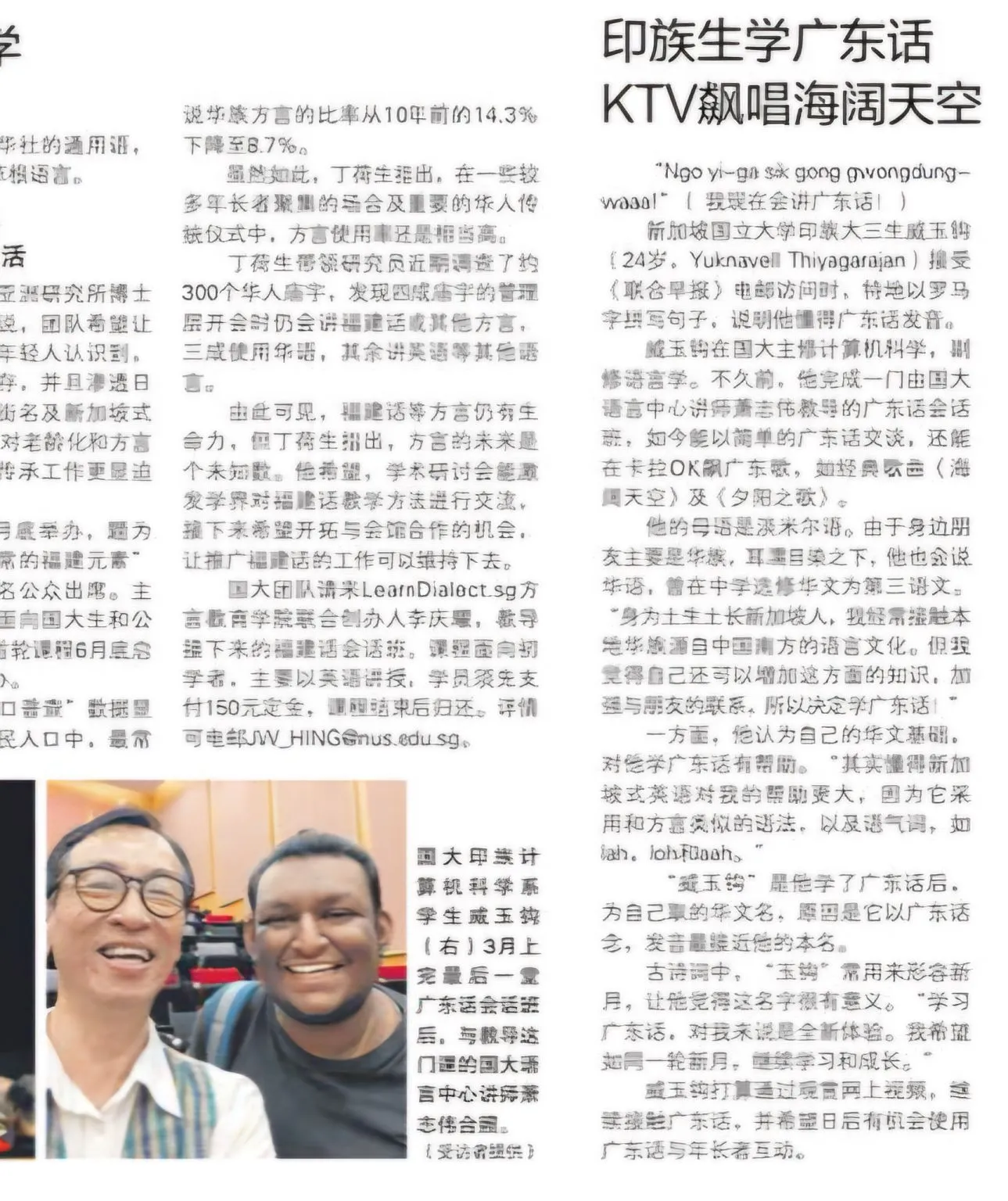
This article uses Jyut-ping to transcribe Cantonese!
Editor note
When first published, Yukna’s chinese name was
你 哋 好 啊 ! 我 叫 威 玉 弘
( 你 们 好 吧 ! 我 叫 威 玉 弘 )
I’m thrilled to share my recent interview with Singapore’s Chinese-medium Lianhe Zaobao newspaper! The interview focused on students and the various Chinese dialects beyond Mandarin.
A few weeks ago, I was approached by Lianhe Zaobao journalist Koh Hsiangyu to discuss my experience learning Cantonese, one of Singapore’s Chinese dialects. This followed my semester-long “Spoken Cantonese” course under the NUS Design-Your-Own-Course scheme. As a Singaporean of Indian descent with Tamil as my mother tongue, my journey learning Cantonese has been unique and rewarding.
I’m amazed that I can understand snippets and phrases, and Cantonese songs have become more meaningful to me. My karaoke repertoire has expanded, with current favorites being
I’ve adopted a Chinese name:
Editor Note:
Yukna has eventually chosen to adopt the name
In Singapore’s fast-paced and competitive environment, especially in education, learning dialects can often be overlooked due to cost, time, and perceived usefulness. However, workshops and non-graded courses in Institutes of Higher Learning (IHLs) provide a valuable opportunity for students to learn dialects without the pressures of grades, fostering a community spirit and cultural immersion.
I envision IHLs running workshops to rekindle community spirit among Singaporeans, bridging gaps between generations and communities. I hope NUS will officially recognize courses like Spoken Cantonese (and Spoken Hokkien), providing the resources and recognition they deserve. Currently, many students are unaware of these courses as they are only spread by word of mouth.
Meanwhile, I’ll continue improving my Cantonese. My older colleagues at my part-time job are impressed but remind me that practice is key; my
I hope to see more of my peers embrace the multitude of cultures we have in Singapore, reigniting the passion for Chinese dialects beyond Mandarin.
Thank you to my